- News
Before the temple, where the people are Magic, Marxist feminism and Khadija El Kharraz Alami’s SHRINE
Performance artist and writer Kopano Maroga talked to Khadija El Kharraz Alami about her new performance SHRINE. The result is a text that takes us into a shared world, where the author and interviewee ask each other questions about where we come from, where we are going, and what connects us.
I’m talking to artist and beloved co-conspirator Khadija El Kharraz Alami over a wobbly Zoom connection through the shining, shimmering and murky as f*ck waters of a Mercury retrograde in Pisces. For the uninitiated, Mercury retrograde is an astrological phenomenon where the planet Mercury appears to be moving backwards from the perspective of Earth. This period in astrology is associated with the inversion of the themes that Mercury normally represents: communication; transmission, cognition. Under a retrograde the invitation is to go internal rather than external: reflect, reorient, reconsider. And, how timely that in 2026 it should coincide with the Christian observation of Lent and the Muslim tradition of Ramadan. All consecrated periods for going inward. Reflecting on one’s relationship with God, with Allah, with Spirit, with anima mundi, the Universe, the Self, the Other. To sit in prayer and poetry and petition. Pisces is the astrological sign that rules over dreams, poetry, the ether, magic, madness, spirituality. So, one could think of a Mercury retrograde in Pisces during Lent and Ramadan as the perfect time to shut the f*ck up and listen to what God’s trying to speak into, and perhaps through, you. The pagan poetry- the holy prayer- that hovers like wafer over the tongue. A perfect time to build a SHRINE.
Google tells me that the word shrine etymologically originates from the Old English, scrīn: cabinet, chest, reliquary. Related to the Latin scrinium: a chest for books. Shrine: a place to keep knowledge; a place to store; a place to keep safe; a place to keep away. Meaningfully different from the etymology of the somewhat synonymous term sanctuary: descended from the Latin sanctus meaning holy, a word from which the word whole is derived. A shrine keeps safe, a sanctuary makes (w)holy. Tangentially, the etymology of the word shrine makes me think of one of my spiritual mentors, Reverend Sushmita Mukherjee’s, reflections on the etymology of the word profane,
This is profane time—
pro fanum: outside the temple.
Before the temple.
The ground on which it stands.
Latin: pro = before; in front of | fanum = temple. Profanus = that which sits outside/in front of the temple. Mukherjee in her linked text above proposes that the profane, more than only being about what is “vulgar, distasteful, everything that the sacred isn’t”, is perhaps an invitation to consider the sacred in the mundane and the mundane in the sacred. Mukherjee proposes that the temple is a place of exclusion. A place reserved for those considered or who consider themselves (w)holy. A place in part defined by who and what cannot be allowed in. Or, as Mukherjee puts it,
Sacred is meant to remain aloof.
Pristine.
Just so.
And then the courtyard:
The wide space before the temple doors
where a mango tree spreads shade
for weary pilgrim and stray dog alike.
Where anyone can sit.
Where beggars hold their bowls
and children play
and someone sings.
This is profane space
No special permission needed.
No credentials required.
The ground that holds everyone
the temple excludes.
Mukherjee continues to ask, “What if the quotidian is holy ground— all you have to do is stop and look”. And this is perhaps where Alami’s practice becomes an operationable example in sacred experimentation with the profane.
The relation of poetics to politics allows me to be uncensored
- Khadija El Kharraz Alami (in an interview with the author)
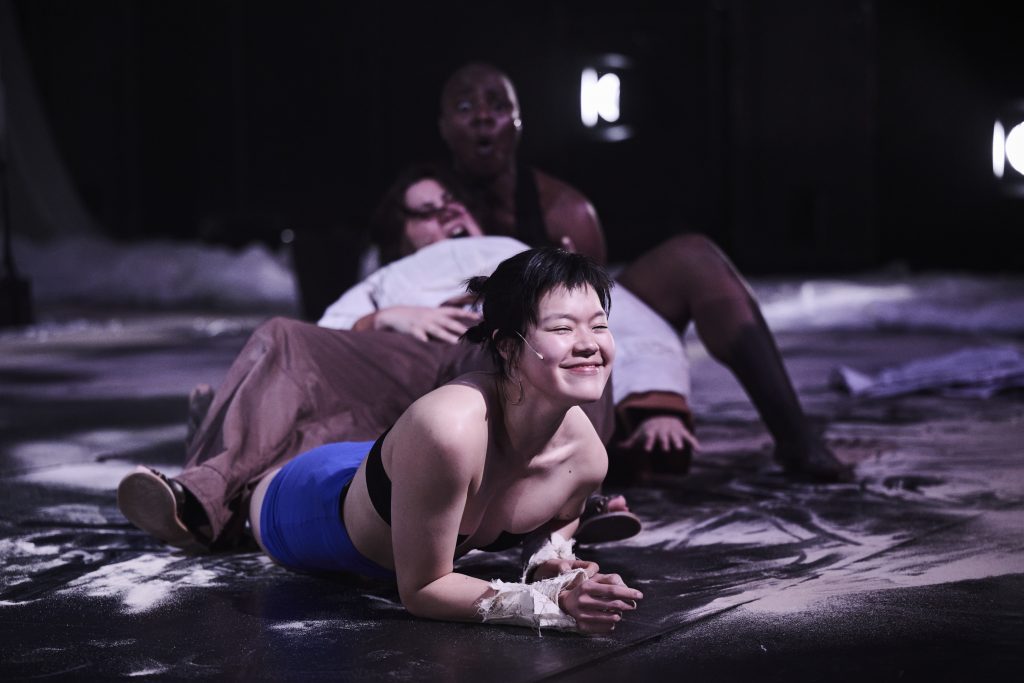
Alami’s work, for me, oscillates between the axes of choreopolitics, choreopoetics, the word (as speech, as text, as liturgy, as poetry, as canon) and the profane. Alami provokes through, not only multidisciplinarity, but through the syncretism of multiple epistemologies. Put another way: for Alami, one wor(l)d is not enough! I remember collaborating as Alami’s dramaturg on her piece The Waves (the piece that initiated her fascination with Silvia Federici, the inspiration for her current work SHRINE). The piece draws inspiration from Viriginia Woolf’s experimental lyric novel of the same name, splicing seven characters’ voices and perspectives in a non-linear temporal framework. I remember how Alami’s work began outside the theatre with performance art interventions from her four companion performers Lois Lumonga Brochez, Isabelle Houdtzagers, Musia Mwankumi and Merel Severs, inspired by the performance-based practices of women such as Ana Mendieta: the Cuban-American performer and sculptor whose tragically untimely death continues to be a patriarchal haunting for the art world, and particularly its women, until today. Alami’s four companions guide the audience to the theatre after their performance art inspired activations of public space where we join Alami herself on stage as she has been preparing the space for our arrival. A deconstructed banquet with subtle reference to Alami’s Moroccan background: dates and mint tea; fruit and floor-seating; sparse streams of silk-like fabrics strewn amongst a smattering of twigs. We sit in-amongst a confluence of worlds. Texts inspired by the non-linearity of Woolf, poetics inspired by the activistic erotics of Audre Lorde, a sprawling and whirling composition of collaged speech and pastiched choreographic proposals that somehow feel like a contemporary performance interpretation of the 1996 cult-classic film The Craft. If witchcraft is the profane practice of utilising the tools of the mundane world to open pathways to the divine (and, perhaps, vice versa: to kill God and empty heaven with Nietzschean hubris), then Alami’s performance work is undoubtedly an example of the witch’s craft: magic. And, if occultist Dione Fortune is to be believed that, “Magic is the art of changing consciousness at will”, Alami is a practitioner par excellence of the magical tradition of shifting reality through a shifting of consciousness.
I’m trying to serve reality, or at least a reflection of it, on a plate of sweets… mint tea, dates, cookies, honey. And, at the same time, there’s blood
-Khadija El Kharraz Alami (in conversation with the author)
The politics of Alami’s work are a direct reflection of her lived experience as a Dutch-Moroccan, queer, woman of the working class. A contradiction-in-terms for her peers of the more dominant and normative identities of whiteness, heterosexuality, middle-classness and non-dual nationality. Alami embraces the witch archetype as she appears in Federici’s work: a dissident, a labourer, a source for extraction and suppression and, yet, a figure that holds the potential power to irrevocably change the world of men. I Caliban and the Witch: Women, the Body and Primitive Accumulation Federici levels the profane argument before the temple of Marxist theory that the Marxist analytical framework of primitive accumulation remains insufficient so long as it does not incorporate a gendered analysis of women as a historically oppressed and exploited labour class. By way of definition: primitive accumulation refers to the foundational hoarding, by theft and mass murder, of capital by the dominant owner-class to form the basis of capitalist rule. This process of primitive accumulation was actioned in the forms of broad-based brute force, such as colonialism, domestic and global warfare and, in general, using force to separate people from their own means of production (e.g land, labour, capital and entrepreneurship) in favour of privatisation that forces workers to depend on wages from the private owner-class as opposed to being able to directly produce what they need for themselves. It is here where Alami’s lived experience and Federici’s building upon Marx come into confluence.
I came to the realization [about my mother] that she couldn’t actually be a mother… as a function. It was all under patriarchal rules of: the woman stays at home, takes care of the children, [performs] unpaid labour, is dependent [financially] on her husband… The government made it impossible for her to be a single mothe
- Khadija El Kharraz Alami (in conversation with the author
)One of Federici’s most prominent arguments inCaliban and the Witch builds on the critique of Marx’s analysis of the oppression of women as a by-product or residual detritus of feudal relations. Rather, Federici argues that the basis of capital, achieved through primitive accumulation, necessarily depends on the historic exploitation of women’s labour in the household. The historically gendered role of mother and wife coincides with the unpaid, reproductive labour that they provide in the domestic environment by literally biologically producing children that will later become part of the workforce (as paid men and unpaid or lesser paid women) as well as creating and maintaining the context that allows the existing workforce (men, in this normative example of the nuclear family) to be able to continue to remain part of the workforce (through systematic preparation of food, maintenance of the home and providing medical, psychological care work etc). For Alami this political analysis has an incredibly personal resonance in witnessing her mother navigate the structural ineptitude of the Dutch government while trying to raise children as a divorced, single mother of Moroccan descent and the resultant strain this took on her mother’s psychological health and the eventual maladaptive, social behaviours that accompany structural violence. Simply put, violence begets violence.
I don’t see a change happening unless we burn everything down
- Khadija El Kharraz Alami (in conversation with the author)
In Alami’s SHRINE the central narrative follows a daughter whose mother is brutally murdered by the state and its apparatuses. Her daughter fights for years, in vain, for a fair trial and, through frustration and sadness, is radicalised to more direct action against systems of power. In the present day, this narrative harkens to the contemporary political movements of recent years seeking justice from the predatory nature of the state and its apparatuses of violence ( eg police, military, judicial systems etc) such as Justice Pour Sourour: a grass-roots movement in Brussels, Belgium that seeks justice for Sourour Abouda (a woman, mother, sister and community worker) who was found dead in police custody under dubious and contestable circumstances, leading to suspicions of foul play on the side of the police. Or, the recent lawsuit taken up by the children of the Civil Rights Movement leader Malcolm X against the Federal Bureau of Investigations, the Central Intelligence Agency and the New York Police Department of the United States of America for collusion in X’s assasination. In Alami’s SHRINE the predatory violence of the state against oppressed and marginalised people becomes the catalyst for both political and spiritual radicalisation, a hearkening to Federici’s proposal that women and witches in post-feudal Europe were demonised because of the political and spiritual power and potential antagonism they represent in the face of the totality of capitalist, patriarchal dominance.
Having not yet seen SHRINE I cannot say what it does or does not do. But, what interests me (maybe even more than what the work does or does not do) is what the work wants. What is the desire of SHRINE. From my vantage point, Alami’s desire is to splice the multiple realities of death and resistance; incredible violence and incredible care; the all encompassing, patriarchal power of the state and the transcendent (possibly matriarchal, though reinforcing binary gender polarities might not be the most interesting proposal) power that spirituality can perhaps (re)imbue us with in our modes of resisting expropriation, domination and termination by the apparatuses of capitalism, imperialism and the state. “Making spirituality a threat again”, as Alami says, quoting Federici.
Share
Related stories
- Theatre
- Decolonial Narratives
- SPRING coproduction
- NL premiere
SHRINE
Khadija El Kharraz Alami
Sun May 17 19:30
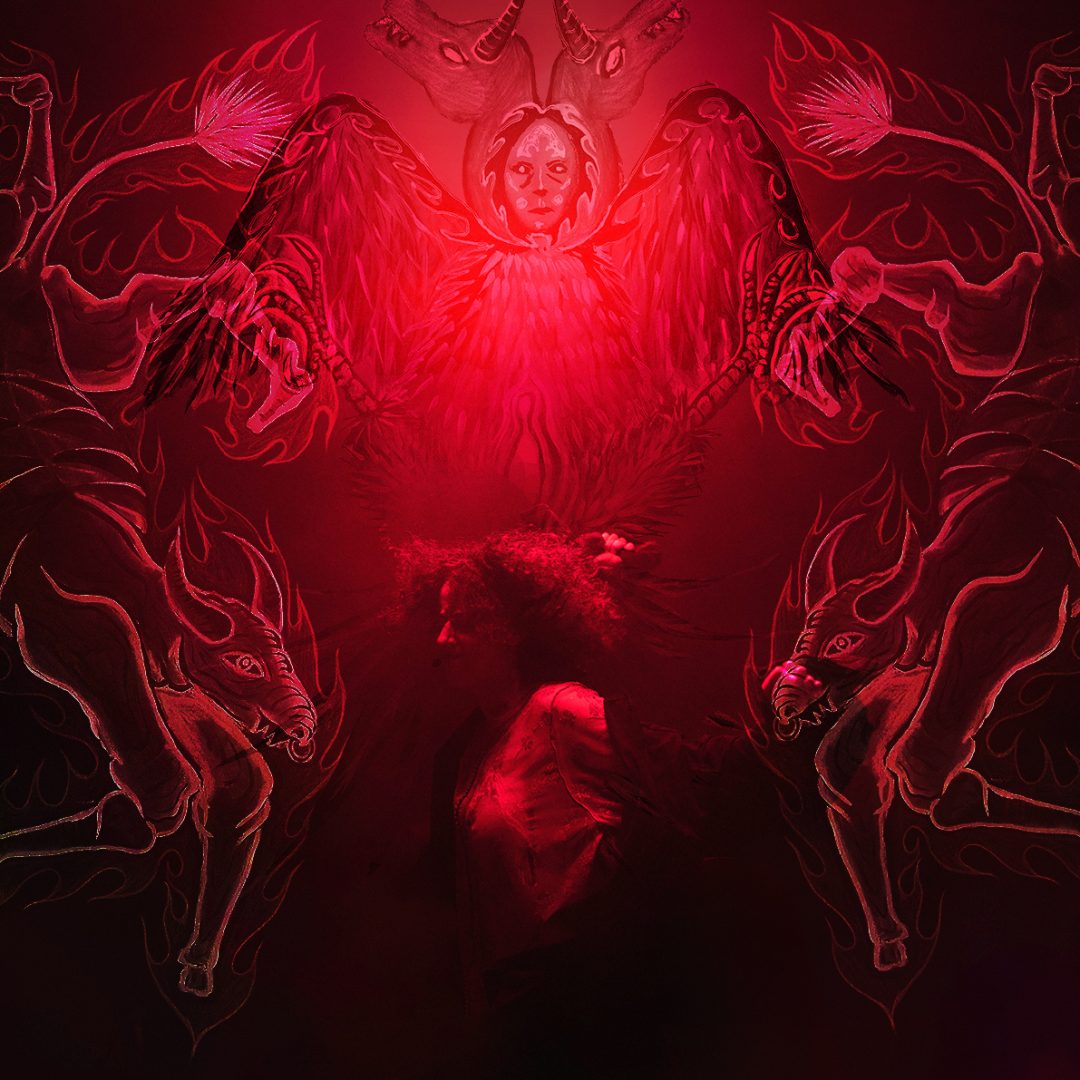
A compelling performance about grief, rage, and radical resistance. After her mother is brutally murdered by 'the system,' the battle-worn Daughter seeks refuge with the Jinns—non-human beings from a parallel world. In their SHRINE, her anger and sorrow are given the space to exist. It is a place of remembrance, prayer, sacrifice, and celebration. El Kharraz Alami takes us into a world where past, present, and future converge.